
I'm also up for an award in the category of unpublished short story.
It's been a while since I posted anything, and a lot of water has gone under the bridge. The East River Ripper was a finalist in two categories in the National Indie Excellence Awards--Regional Non-Fiction Northeast and True Crime. It got a Bronze Medal for Regional Non-Fiction from the Independent Publishers Book Awards. And it got a Bronze Medal in the category Political/Current Events in the Florida Authors and Publishers Association President's Awards. Finally, it is a semi-finalist in the Royal Palm Literary Awards--category of History. I also have an unpublished short story on the semi-finalist list. Awards will be announced at the Florida Writers Association Convention in Orlando on October 29.
I am also working on another true crime history about a murder case that was tried in Toronto in 1895. At the time it was touted as "Canada's Greatest Case." It has been a rough row to hoe in getting the book written. The pandemic lockdown delayed getting essential references from libraries and archives which had been shut down, and knee replacement surgery sidelined me for a while. I'm finally on the last chapter, and then I need to go back and trim the excess verbiage. I should be ready to start shopping the book to publishers by the end of the year.
I've decided that for my next project I'm going to try my hand at writing a novel. Checking and rechecking references for nonfiction work is a tedious process. It might be fun to be able to make stuff up without having to fact-check it.
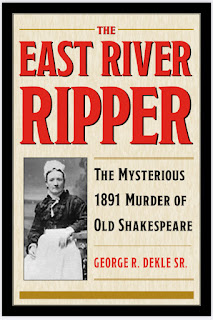
The December 2021 issue of Ripperologist: The Journal of Jack the Ripper, East End and Victorian Studies contains an interview I gave to How Brown, the proprietor of the website CarrieBrown.net, and Mr. Brown has graciously agreed to allow me to reprint the article on my blog.

THE
EAST RIVER RIPPER
THE
MYSTERIOUS 1891 MURDER OF OLD SHAKESPEARE
By HOWARD
BROWN
Recently
released by the Kent State University Press was The East River Ripper: The
Mysterious 1891 Murder of Old Shakespeare by author George R. Dekle, the
first full-length book on the murder of Carrie Brown. Her death has seen much
discussion over the years as to whether it was the work of the Whitechapel
murderer.
“This book
will, for the first time, give an accurate history of the East River Ripper
case. It will not give an infallible account of what really happened. No
history can do that. All history can do is reconstruct an account of what
probably happened. The more numerous and reliable the sources, the more
meticulous the historian, the more accurate the history can be, and no effort
has been spared in making this history as true to what really happened as humanly
possible.”- George R. Dekle, from his Introduction.
Professor Dekle, not only the first crime scholar to have written a full-length book about the 1891 murder of Carrie Brown, the trial of Amir Ben Ali, and the aftermath to this Gilded Age mystery, is perhaps the best person who might have written a book about the case. His legal background separates him from the pack by the very fact that he covers Ali’s trial, and does considerable damage to the long-held belief that Ali was framed by the NYPD, a belief which came about almost immediately after the June/July 1891 trial.
Professor
Dekle provides alternative theories as to who committed the murder, and leaves
the casual reader and Brownian researcher the option of choosing which of his
alternatives is closest to the truth as to whodunit.
The book
doesn’t shut doors, but rather opens them in terms of encouraging further
research into the East River Hotel murder.
The East
River Ripper is a must-have book for aficionados of Gilded Age
American crime and true-crime devotees of every stripe.
u
FIVE
QUESTIONS WITH GEORGE R. DEKLE
1: When did you begin
your research into the Carrie Brown murder and Ali trial? How much time, from
the beginning of the research until the completion, did it take for you to
complete the work?
Toward the
end of 2018 as I was finishing up my last book, Six Capsules: The Gilded Age
Murder of Helen Potts, I decided to write a professional biography of the
lead prosecutor in that case, Francis L. Wellman. The format would be to give a
chronological account of his murder trials, devoting a chapter to each one. I
had followed this path once before, when I wrote Abraham Lincoln’s Most Famous
Case: The Almanac Trial. Upon finishing The Almanac Trial, I then
wrote Prairie Defender: The Murder Trials of Abraham Lincoln.
I started on my project exactly as I did
on Prairie Defender. I amassed all the information I could on every
murder case that Wellman tried, and then began writing the book. When I hit the
second chapter, I said to myself, “This case deserves a book unto itself,” but
I forged ahead. When I got to the fifth chapter, I said, “It’s impossible. This
case has to be a book unto itself.” Then I really dug into the research on the
Carrie Brown case and uncovered a wealth of information that confirmed my
opinion. I set aside the professional biography of Wellman and wrote The
East River Ripper instead.
I worked on the book from October of 2018 until January of 2020, at which time I had a completed manuscript. KSU Press accepted it for publication, and for the next six months I worked on responding to the critiques of the peer reviewers, rewriting to address the critiques, correcting mistakes found by the copyeditor, reviewing proof pages, and indexing.
2: What was
the most interesting part during your research? Scouring the trial transcripts?
Reviewing first hand accounts, or something else?
The most
interesting moments during my research were the times that I found things which
had certainly been overlooked by the lawyers trying the case and apparently
overlooked by later writers on the case. As I tried to point out in the book,
the prosecution didn’t put on nearly as strong a case as they could have, and
the defense missed gaping holes in the prosecution case that they might very
well have exploited to achieve an acquittal.
3: When you
give the reader three alternatives to a solution in this case, was it entirely
for the reader or are you not entirely convinced an answer or solution is
etched in stone yourself.... or both?
I talk about some of the
principles of evidentiary analysis when I give the three case theories. One
really important principle that I had to learn the hard way is: “Don’t get
tunnel vision.” Don’t latch onto a theory and defend it at all costs no matter
what new evidence turns up. Byrnes didn’t do himself any favors by latching
onto the “Frenchy No. 2” theory and not giving up on it until he had
established that “Frenchy No. 2” had an ironclad alibi. Then he continued to
let the public think that he was looking for Frenchy No. 2 and wound up with
egg on the face when he arrested Ben Ali.
You look at the evidence and devise theories which explain as much of the known evidence as possible. Then you test those theories to see if they hold up under scrutiny. The three theories I advance in the book were what I believed to be the three most plausible theories. Any one of them has a claim to being true, but which is most likely true? In devising the three theories, I looked at all the evidence without analyzing its weight. In choosing among the three theories, I weighed the evidence, accepting what I felt was more believable and rejecting what I felt was less believable. The weighing of evidence is a more subjective process than simply looking to find the existence of evidence.
Could I be wrong about whether
Ben Ali committed the murder? Certainly I could. As Oliver Cromwell wrote to
the Church of Scotland, “I beseech you, in the bowels of Christ, consider that
you might be mistaken.” This dictum gave rise to the scientific principle known
as Cromwell’s Rule: “Never assign a probability of 1 or 0 to any proposition.”
Statistician David Lindley coined the term, and he illustrated it by saying
that you should “leave a little probability for the moon being made of green
cheese; it can be as small as 1 in a million, but have it there since otherwise
an army of astronauts returning with samples of the said cheese will leave you
unmoved.”
Somewhere out there someone may find a piece of evidence that proves beyond peradventure that Ben Ali was innocent. I think it’s unlikely, but it could happen. What I haven’t seen is any evidence whatsoever that the police, the expert witnesses, and/or the prosecutors colluded together to frame an innocent man. The only “evidence” of a frame job that I found was the unsubstantiated allegations in the press that Ben Ali was “railroaded” and Charles Russell’s statement in his highly inaccurate magazine article that there was “something strange” about the blood evidence. These allegations got repeated over time until the acorns of allegation grew into the oak forest of certainty.
Sometimes people can get trapped in a web of circumstances indicating guilt that they cannot extricate themselves from, and that may well have occurred in Ben Ali’s case. I handled a murder case once where an idiot kept doing stupid things that made him look guilty. I felt sure I could have convicted him at trial, but I was just as sure that he was innocent. We didn’t arrest him, and a year later we were able to arrest the man who actually did commit the murder. When I was a defense attorney I had a client who accidentally killed his girlfriend and then staged the scene to make it look like a rape-murder and throw suspicion on someone else. He took a manslaughter and turned it into a first degree murder and wound up getting sentenced to life instead of 15 years for manslaughter.
You get more false convictions from bad luck and bad judgment than from bad police officers.
4: If you
were a defense lawyer for Ali. what would have been (at least) one strategy you
would have undertaken that the trio didn’t, or one that you would have handled
better?
The
prosecution went to trial unprepared. Francis Wellman delivered what seemed
like a good opening statement, but it had gaping holes in it where he said things
that he could not prove. The defense did not take advantage of these failures
of proof. They actually papered over one of them. The prosecution wound up
putting on a better case than what they said in opening (but not nearly as good
a case as they could have), and the defense responded to that case with experts
who could easily have been turned to support the testimony of the prosecution
experts. The prosecution fumbled badly in their handling of the defense
experts. Instead of using the defense experts to bolster their own experts,
they attacked the defense experts.
The way to defend Ben Ali was to defend against Wellman’s opening statement, not against the evidence presented at trial. In taking that approach, the defense could ignore most of the damning new evidence that hadn’t been mentioned in opening statement and cross-examine the prosecution experts to have them underline all the things that Wellman had said but failed to prove. I would have worked hard to keep Ben Ali off the witness stand. He never looked more guilty than when he was denying his guilt. Wellman butchered him on cross-examination, and that may well have been the turning point of the trial. More times than I can remember I have seen a defendant who was sailing toward a not guilty verdict take the witness stand and snatch defeat from the jaws of victory by lying like a cheap clock. Usually it was a client I couldn’t talk out of testifying.
It might be hubris on my part, but I think I could have gotten Ben Ali acquitted by following the strategy outlined above. I don’t mean by my remarks to disparage the efforts of either side. They both worked hard, and both sides did enough to win the case before the right jury. The problem was that the only truly experienced criminal trial lawyer among the six lawyers was De Lancey Nicoll, and he was only a mediocre trial advocate. The other lawyers were talented, and they occasionally showed flashes of brilliance, but they all needed some seasoning in the trial of murder cases. Wellman was a quick study, and he showed vast improvement in his next case, the Carlyle Harris case chronicled in Six Capsules.
5: Our opinion of George Damon, the
Cranford, N.J. man who came forward with the key to room 31 approximately a
decade after Ali had been in various institutions, is probably the same. What
might differ is what reason he had for coming forward. Do you believe this
reason was self-serving or altruistic?
If George
Damon was telling the truth, what else must be true? (1) It must be true that
the police had no hope of ever finding out the true identity of “C. Knicklo.”
Damon, the only man who knew it, was concealing it. (2) It must be true that
the police had no hope of ever finding the key to the death room. Damon was
concealing it. (3) It must be true that George Damon valued his personal
convenience over the life of an innocent man. Ben Ali stood in danger of death
in the electric chair and only Damon could save him. (4) It must be true that
George Damon didn’t give a damn about the proper administration of justice.
Conclusion: George Damon was the real villain of the tragedy of Ben Ali’s false
conviction.
The
unspoken theme of George Damon’s testimony, whether true or false, is “I’m a
dirtbag.” When someone says, “I’m the kind of guy who will let an innocent man
die in the electric chair,” he’s not the kind of guy I’m going to rely on to
tell the truth. And he’s not the kind of guy I’m going to expect to act from
pure motives. I’ve had quite a bit of experience with post-conviction
“exculpatory” witnesses, most of them as a defense attorney. The usual scenario
was that the witness came to me and said, “What do I have to say to get the
defendant’s conviction overturned?” None of these witnesses were motivated by
altruism. I suggested one selfish motive for Damon to fabricate the story of
Frank the Disappearing Dane in the book. There may have been others for which
we have no evidence.
u
HOWARD
BROWN is the owner of CarrieBrown.Net, the foremost online archive and
discussion site on the Carrie Brown murder.
I just registered as one of the exhibitors at the Sunshine State Book Festival, which is to be held in the Oaks Mall, Gainesville, on Saturday, January 29, 2022, with lectures the next afternoon at the Matheson History Museum. More information on the festival can be found HERE.
I will be featuring my latest book, The East River Ripper: The Mysterious 1891 Murder of Old Shakespeare, but I will have copies of most of my other books, including The Last Murder: The Investigation, Prosecution, and Execution of Ted Bundy and Six Capsules: The Gilded Age Murder of Helen Potts.
If you are a bibliophile (aka bookworm), you won't want to miss this event.
One comment on the Rittenhouse verdict before I give my analysis: To paraphrase the Old Bailey barrister Horace Rumpole, “A criminal trial is a pretty blunt instrument for settling questions of public policy.” The acquittal of Rittenhouse does not mean that the Civil Rights movement is dead. It does not mean that it’s open season for would-be vigilantes to go around shooting people. All it means is that the prosecution failed to prove Rittenhouse guilty beyond a reasonable doubt.
Let me begin my critique with a digression:
In December of 1946, 5’7”, 130-pound Medal of Honor winner Audie Murphy, who had a baby face and was dressed in a business suit, picked up a 6’2” 190-pound hitchhiker. The hitchhiker shoved a .45 into Murphy’s ribs and attempted to carjack him. When Murphy was ordered to stop the car, he grabbed the man’s gun hand and punched him, knocking him out of the car. Then Murphy went into the ground-and-pound offense and eventually knocked the man out. As the news photo taken at the jail showed, Murphy’s suit was unruffled. We can’t say the same for the carjacker who experienced what Jeff Cooper called “a critical breakdown in the victim selection process.” If Murphy had been 6’2” himself with a scarred face and bulging muscles, the robber probably wouldn’t have attacked him.
If Kyle Rittenhouse had been a muscular behemoth with scars
on his face and tattoos on his arms, it is unlikely he would have been
attacked. Instead, he was a slightly built, baby-faced youngster who looked
like he was not “man enough” to use the semi-automatic rifle he was packing. He
had exercised abominable judgement in going to Kenosha, abominable judgement in
arming himself with an “assault rifle,” and abominable judgement when he went
into harm’s way looking like a wannabe bad guy who had jumped in way over his
head by carrying a rifle into a riot. But stupidity is not yet a criminal
offense. It's a pity that some police officer didn’t tell him, “Son, you’d
better go home before someone takes your rifle away and gives you an AR-15
suppository.”
Rittenhouse was a sitting duck for “tough guys” who might
think they could take him down a peg without running the risk of serious injuries.
I don’t know what motivated the men who confronted Rittenhouse. They may have
acted from motives as pure as the driven snow, but they too were exercising
abominable judgement by violently engaging a man armed with a semiautomatic rifle.
He may have looked like a wimp, but it doesn’t take Man Mountain Dean to
operate the 5.5 to 9.5 pound trigger pull on an AR-15 style weapon.
In a series of confrontations with men exercising judgement
as poor as his own, Rittenhouse acted like a youngster who had jumped in over
his head, but he followed up his series of bad decisions with a prudent series
of acts. He tried to disengage. He proclaimed his lack of aggressiveness, and he
ran away. Then he did something unexpected—he fired his rifle in self-defense.
When the dust settled and the smoke cleared, two men lay dead and another was
critically injured. A Medical Examiner friend of mine once told me "It takes three screwups to make a disaster." There were far more than three screwups in this scenario, and they culminated in a disaster of monumental proportions.
I prosecuted for 30 years, and I defended for two years
before that, and I have lost count of the number of homicide cases I prosecuted
and defended over the years. I have seen juries acquit on grounds of
self-defense in cases where the defendant had done far less to try to defuse
and withdraw from a confrontation. If the Rittenhouse case had come across my
desk, I would have resisted the filing of charges against Rittenhouse with all
my heart and soul and sinew. If I were ordered by my superiors to prosecute the
case, I would have told them that I could not. And they wouldn’t have had to
ask me why I refused. I would have told them. I would have said, “I believe
Kyle Rittenhouse is not guilty of murder.” If there had been a law on the books
in Wisconsin prohibiting “Stupidity Resulting in Death,” I would gladly have
prosecuted Rittenhouse for that, but life is too short and jobs are too
plentiful for me to be coerced into prosecuting someone I believe to be
innocent of murder.
Thankfully, I don’t believe it would have come to that if
the case had come into our office. Both the elected prosecutors for whom I worked
were men of sterling reputation and excellent judgment. They would never
aggressively pursue charges against someone who had done so much to avoid
having to use deadly force.
After I retired from active practice, I taught a class on prosecution at a law school for ten years. One principle I tried to drill into the heads of aspiring prosecutors was this: Sometimes prosecutors do their best work when they resist political pressure and refuse to file iffy charges.
