Sunday, December 12, 2021

THE SUNSHINE STATE BOOK FESTIVAL (JANUARY 29, 30, 2022)

 I just registered as one of the exhibitors at the Sunshine State Book Festival, which is to be held in the Oaks Mall, Gainesville, on Saturday, January 29, 2022, with lectures the next afternoon at the Matheson History Museum. More information on the festival can be found HERE.

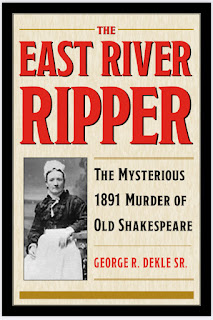
I will be featuring my latest book, The East River Ripper: The Mysterious 1891 Murder of Old Shakespeare, but I will have copies of most of my other books, including The Last Murder: The Investigation, Prosecution, and Execution of Ted Bundy and Six Capsules: The Gilded Age Murder of Helen Potts.

If you are a bibliophile (aka bookworm), you won't want to miss this event.


Friday, November 19, 2021

THOUGHTS ON THE KYLE RITTENHOUSE VERDICT


One comment on the Rittenhouse verdict before I give my analysis: To paraphrase the Old Bailey barrister Horace Rumpole, “A criminal trial is a pretty blunt instrument for settling questions of public policy.” The acquittal of Rittenhouse does not mean that the Civil Rights movement is dead. It does not mean that it’s open season for would-be vigilantes to go around shooting people. All it means is that the prosecution failed to prove Rittenhouse guilty beyond a reasonable doubt.  

Let me begin my critique with a digression:

In December of 1946, 5’7”, 130-pound Medal of Honor winner Audie Murphy, who had a baby face and was dressed in a business suit, picked up a 6’2” 190-pound hitchhiker. The hitchhiker shoved a .45 into Murphy’s ribs and attempted to carjack him. When Murphy was ordered to stop the car, he grabbed the man’s gun hand and punched him, knocking him out of the car. Then Murphy went into the ground-and-pound offense and eventually knocked the man out. As the news photo taken at the jail showed, Murphy’s suit was unruffled. We can’t say the same for the carjacker who experienced what Jeff Cooper called “a critical breakdown in the victim selection process.” If Murphy had been 6’2” himself with a scarred face and bulging muscles, the robber probably wouldn’t have attacked him.

If Kyle Rittenhouse had been a muscular behemoth with scars on his face and tattoos on his arms, it is unlikely he would have been attacked. Instead, he was a slightly built, baby-faced youngster who looked like he was not “man enough” to use the semi-automatic rifle he was packing. He had exercised abominable judgement in going to Kenosha, abominable judgement in arming himself with an “assault rifle,” and abominable judgement when he went into harm’s way looking like a wannabe bad guy who had jumped in way over his head by carrying a rifle into a riot. But stupidity is not yet a criminal offense. It's a pity that some police officer didn’t tell him, “Son, you’d better go home before someone takes your rifle away and gives you an AR-15 suppository.”

Rittenhouse was a sitting duck for “tough guys” who might think they could take him down a peg without running the risk of serious injuries. I don’t know what motivated the men who confronted Rittenhouse. They may have acted from motives as pure as the driven snow, but they too were exercising abominable judgement by violently engaging a man armed with a semiautomatic rifle. He may have looked like a wimp, but it doesn’t take Man Mountain Dean to operate the 5.5 to 9.5 pound trigger pull on an AR-15 style weapon.

In a series of confrontations with men exercising judgement as poor as his own, Rittenhouse acted like a youngster who had jumped in over his head, but he followed up his series of bad decisions with a prudent series of acts. He tried to disengage. He proclaimed his lack of aggressiveness, and he ran away. Then he did something unexpected—he fired his rifle in self-defense. When the dust settled and the smoke cleared, two men lay dead and another was critically injured. A Medical Examiner friend of mine once told me "It takes three screwups to make a disaster." There were far more than three screwups in this scenario, and they culminated in a disaster of monumental proportions.

I prosecuted for 30 years, and I defended for two years before that, and I have lost count of the number of homicide cases I prosecuted and defended over the years. I have seen juries acquit on grounds of self-defense in cases where the defendant had done far less to try to defuse and withdraw from a confrontation. If the Rittenhouse case had come across my desk, I would have resisted the filing of charges against Rittenhouse with all my heart and soul and sinew. If I were ordered by my superiors to prosecute the case, I would have told them that I could not. And they wouldn’t have had to ask me why I refused. I would have told them. I would have said, “I believe Kyle Rittenhouse is not guilty of murder.” If there had been a law on the books in Wisconsin prohibiting “Stupidity Resulting in Death,” I would gladly have prosecuted Rittenhouse for that, but life is too short and jobs are too plentiful for me to be coerced into prosecuting someone I believe to be innocent of murder.

Thankfully, I don’t believe it would have come to that if the case had come into our office. Both the elected prosecutors for whom I worked were men of sterling reputation and excellent judgment. They would never aggressively pursue charges against someone who had done so much to avoid having to use deadly force.

After I retired from active practice, I taught a class on prosecution at a law school for ten years. One principle I tried to drill into the heads of aspiring prosecutors was this: Sometimes prosecutors do their best work when they resist political pressure and refuse to file iffy charges.


Wednesday, October 27, 2021

WOMEN'S SPORTS, WOMEN'S SAFETY, AND FUNDAMENTAL FAIRNESS

Caitlyn Jenner, who won an Olympic Gold Medal in the men’s marathon before transitioning to female, just came out against trangendered women competing in women’s sports. This might seem both unenlightened given our recent trend to gender neutrality and unnecessary given the fact that TV shows, TV ads, and in the movies constantly bombard us with depictions of lithe, svelte, beautiful women outdoing males in all sorts of physical activities from combat sports to track and field, and even to opening stuck jar lids. And there are women who have successfully competed at the highest level of sports against men. Babe Didrikson Zaharis comes to mind. 

The current furor over the issue of trangendered females competing against biological females ignores the reason we have women’s sports. I think the reason which can easily be demonstrated by looking at a few sports records to see if women excel men in real life as completely as they do on TV and in the movies: 

NOTE: Boys’ records come from the Florida State High School Activities Association’s record books for weightlifting and track and field. The women’s records can easily be checked on Google.

We see that the only two events where world champion professional women outperform amateur high school boys are the shot put and the discus. Of course, the women are tossing much lighter implements than the boys. 

Let’s use these statistics to perform a thought experiment: What if we jumped in our time machine, went and got these boys at the age and stage of development they had attained when they set these state records, convinced them that they were really girls, and entered them in the 2024 Summer Olympics? They would be competing against world class professional women who had trained almost their whole lives to excel in their sports. How would they do? These amateur teenagers who had been practicing their sport for only a few years would probably bring home a sack full of gold medals. 

We have women’s sports because a person with a woman’s body cannot be expected to compete with people who have men’s bodies in contests of strength, power, and speed. It is a biological fact that is ignored only at the peril of the safety of people with women’s bodies. 

When Cecil decides that he is a woman trapped in a man’s body and gets his gender reassigned to become Cecilia, changing to feminine pronouns when referring to her does not change the fact that Cecilia still has a man’s body. As proof of that proposition, I offer as evidence the y chromosome and the prostate gland, neither of which exist in the bodies of biological females. The y chromosome gives men a number of attributes relevant to fairness in sporting competition—bigger bodies, stronger bodies, more testosterone, and facial hair. 

In contact sports like baseball, basketball, and lacrosse, this is going result in physical injuries to biological females. In collision sports like football, boxing, and MMA it can result in catastrophic physical injuries. 

The main reason I see for allowing trangendered females to compete in women’s sports is the fact that their feelings will be hurt if they are excluded. I have a suggested remedy for the psychological injury that a transgendered woman might feel because she is being excluded from women’s sports—complete gender-neutrality in sports. Do away with men’s and women’s categories in sports and go to two divisions. One division, let’s call it the Y Division, will be open to anyone who wishes to compete, male or female, cisgendered, transgendered, pangendered, or ungendered. The second division, let’s call it the X Division, will be closed to anyone endowed with a y chromosome.

Thursday, October 7, 2021

THE ROLE OF THE PROSECUTOR

Britton Bath Osler

 On May 23, 1895, Britton Bath Osler, the greatest Canadian prosecutor of the 19th century rose to make his final argument in the most sensational murder case that had ever been tried in the courts of Toronto. Arrayed against him on the other side were two of the most distinguished defense attorneys of the age, and they were aided by a man who was arguably the greatest American prosecutor of the 19th century, Francis L. Wellman, who had recently gone into private practice in New York City. Defense counsel, having spoken for almost eight hours, had ended their argument with an impassioned plea to spare the defendants' lives and return them to their wives and aged mother.


In attempting to defang the powerful arguments of his opposition, Osler called upon the jury to be guided by facts, not emotion. He then gave a statement of the role of a prosecutor which should be etched in the heart of all prosecutors everywhere:

"My function is simply to aid you in getting at the truth, and is entirely different from that of the prisoners’ counsel. It is the duty of the Crown' counsel to press home the facts. It is not his duty to present facts with an apology for presenting them against the prisoners. He is to treat the prisoners fairly, rightly; conceal no evidence that comes to his knowledge. He has to aid you in coming to a just conclusion upon the facts, and if acquittal follows and he has done his duty that is all the community asks of him."

William Randall Slaughter, the State Attorney of the Third Judicial Circuit when I began practicing law, made a similar statement when he told me, "A prosecutor doesn't win a case by getting a guilty verdict. A prosecutor wins a case by getting past a judgment of acquittal and getting a jury verdict. Whatever the jury says, the prosecutor has done his job." His language was a little more colorful than what I have reported, but I try to keep things on a PG level.

My next project, if I live long enough to complete it, will be a chronicle of this long-forgotten episode in Canadian legal history. It is, for me at least, a fascinating look at a titanic legal struggle in a court system that is somewhat unfamiliar to modern Americans.